

The Honest Guide to Countertops

If you were renovating a kitchen in the late nineties or early 2000s, your countertop conversation was fairly straightforward. Laminate was the budget standard, tile was common in warmer climates, and granite was the aspirational upgrade that signaled a serious kitchen. Marble existed in high-end homes and bakeries, admired for its beauty and tolerated for its demands. That was essentially the menu.
What happened over the following two decades changed everything. Quartz manufacturers invested heavily in brand positioning, showrooms, and designer partnerships, and they got extraordinarily good at producing slabs that mimicked the look of marble — the soft white backgrounds, the grey veining, the elegant movement — without any of marble's maintenance demands.
At the same time, granite's available palette in the mainstream market was still dominated by browns, beiges, and busy speckled patterns that felt increasingly dated against the cleaner, more minimal direction residential design was moving. Engineered quartz filled that gap deliberately and effectively. The market shifted, the showrooms followed, and suddenly homeowners had more options and more confusion than ever before. That confusion is worth clearing up — because the right countertop for your kitchen has less to do with what's trending and more to do with how you actually live.
Granite — the original and still very much relevant
Granite has been the residential kitchen standard for so long that it almost became a punchline. For a stretch in the mid-2010s, design media declared it over — too common, associated with the beige-and-oak kitchens of the early 2000s. What actually happened is that the commodity version of granite fell out of fashion while the material itself quietly held its ground. Today's granite selections — leathered finishes, dramatic dark slabs, stones with real movement and character — feel completely current. The stigma was always about the grade, not the stone.
Granite is worth reconsidering today goes well beyond the slab itself. It's a natural stone, which means every piece is genuinely one of a kind, and the range of finishes available to natural stone is something no engineered material can replicate. A polished granite has the high gloss most people picture. A honed granite is matte and smooth, quieter and more contemporary in feeling. A leathered finish — created by running diamond-tipped brushes over a honed surface — produces something different entirely: a subtle, tactile texture with a soft sheen where the unique mineral composition of each stone means no two surfaces ever look exactly alike.
The peaks and valleys that form during that process are a direct result of the varying hardness of the minerals within the stone — feldspar, mica, quartz — which is why the finish can't be authentically replicated on an engineered surface. There's also a flamed finish, achieved by exposing the stone to intense heat that causes surface crystals to burst and roughen — a dramatic, highly textured result used more often in outdoor applications but striking in the right interior. These finishes exist exclusively in the world of natural stone, and they represent a dimension of design possibility that simply isn't available anywhere else.
The shift became easier with pricing. Higher grade granite — the slabs with real drama, strong veining, and genuine character — sits in roughly the same price range as a good quartz. So when homeowners were weighing their options and quartz was offering a marble look with zero maintenance at a comparable price point, granite had a harder case to make. It wasn't that granite became expensive. It's that the value proposition of quartz quietly outgrew it for a certain type of buyer.
What makes granite worth understanding today is its practical profile. It's a natural stone, which means every slab is genuinely one of a kind. It handles heat well, it's highly scratch-resistant, and it's available at price points that can work across a wide range of budgets depending on the slab grade. The maintenance requirement is real — it's porous, so it needs to be sealed, typically once a year — but it's manageable, and most homeowners adapt to it without much disruption. The fabrication community knows granite extremely well, which means fewer surprises during installation.

What quartzite actually is and why it matters
Quartzite is where the confusion tends to pile up. The name sounds like quartz. It is not quartz. Quartzite is a natural metamorphic stone — sandstone that's been subjected to intense heat and pressure over geologic time, which gives it exceptional hardness and a luminous, layered quality that no engineered material has been able to convincingly replicate.
It's also porous, which surprises people who assume that because it's harder than granite, it requires less maintenance. The opposite can be true. It needs sealing and it needs to be sourced carefully, because quality varies significantly between quarries and even between slabs from the same quarry.
Hardness is worth understanding here because it comes up constantly in showrooms and almost never gets explained properly. The MOH scale measures a mineral's resistance to scratching, running from 1 — which is talc, essentially powder — to 10, which is diamond. For context, a standard kitchen knife sits around 6.5. Granite typically falls between 6 and 7 on that scale, which is why it holds up so well to daily kitchen use. Quartzite comes in at 7 and above, making it one of the hardest natural stones available for residential applications. Engineered quartz, despite the name confusion, also scores around 7, though its resin content means it responds differently to heat than a true stone would. Marble, by comparison, sits between 3 and 4 — beautiful, and with improved sealants increasingly practical, but softer relative to everything else on this list, which is the root of its maintenance reputation and why etching happens as easily as it does.
If you have been on Instagram or walked through a high-end showroom recently, you have almost certainly encountered Taj Mahal quartzite whether you knew it by name or not. It has become one of the most sought-after stones in residential design — a soft ivory and cream background with warm beige and gold veining that photographs beautifully and works equally well with warm wood cabinetry, painted whites, and everything in between. Its versatility is genuinely rare in natural stone. For homeowners who love the look of marble but want a surface that holds up to daily life, Taj Mahal makes a compelling case. It is not inexpensive — expect to pay at the higher end of the countertop market — but for the right kitchen it is one of those selections that simply doesn't date.
The Macaubas family of quartzites has also been gaining significant ground. White Macaubas offers elegant white tones with light gray veining that brightens spaces and pairs cleanly with contemporary cabinetry, while Fantasy Macaubas features gray and white movement that delivers a more dramatic, high-impact look. For homeowners looking for something truly distinctive, Cristallo quartzite offers a sparkly, translucent quality that makes it a bold statement piece, and Sea Pearl brings a softer, cooler movement with green and gray undertones that works particularly well in kitchens leaning toward a more organic, nature-inspired palette.


Engineered quartz — where practicality meets good looks
Quartz — the engineered version — is what I specify most often for Atlanta suburban households with real, daily kitchens. It's manufactured from roughly 90 to 95 percent ground quartz crystal bound with resin, which makes it non-porous, consistent in color and pattern, and completely maintenance-free in terms of sealing. It doesn't harbor bacteria, it resists staining, and it holds up gracefully in the kind of kitchen where someone is cooking dinner every night while someone else is doing homework at the island.
The honest limitations are worth naming. Quartz doesn't love direct heat — set hot pans on it repeatedly and you risk discoloration or cracking from thermal shock. It's not UV-stable, which makes it a poor choice for outdoor kitchens or countertops that sit in direct sun all afternoon. And because it's engineered, it doesn't have the organic depth and variation of natural stone. For homeowners who want that, quartz will always feel like a compromise.
There is a broader conversation worth being aware of when specifying engineered quartz, and it centers on the fabrication process rather than the finished product in your home. Engineered quartz slabs contain very high concentrations of crystalline silica — and when those slabs are cut, ground, and polished during fabrication, fine silica dust is released into the air. Prolonged inhalation of that dust causes silicosis, an irreversible and potentially fatal lung disease. This is not a theoretical concern — cases have been documented across multiple states, and the conversation has reached regulatory bodies and the courts. The countertops themselves are not a risk to homeowners once installed, but the supply chain that produces them carries a real human cost that is increasingly part of how designers and consumers are thinking about material choices. It doesn't disqualify quartz — its performance characteristics are genuinely strong — but it's a dimension of the material that deserves to be part of an honest conversation.

Porcelain — the newcomer that means business
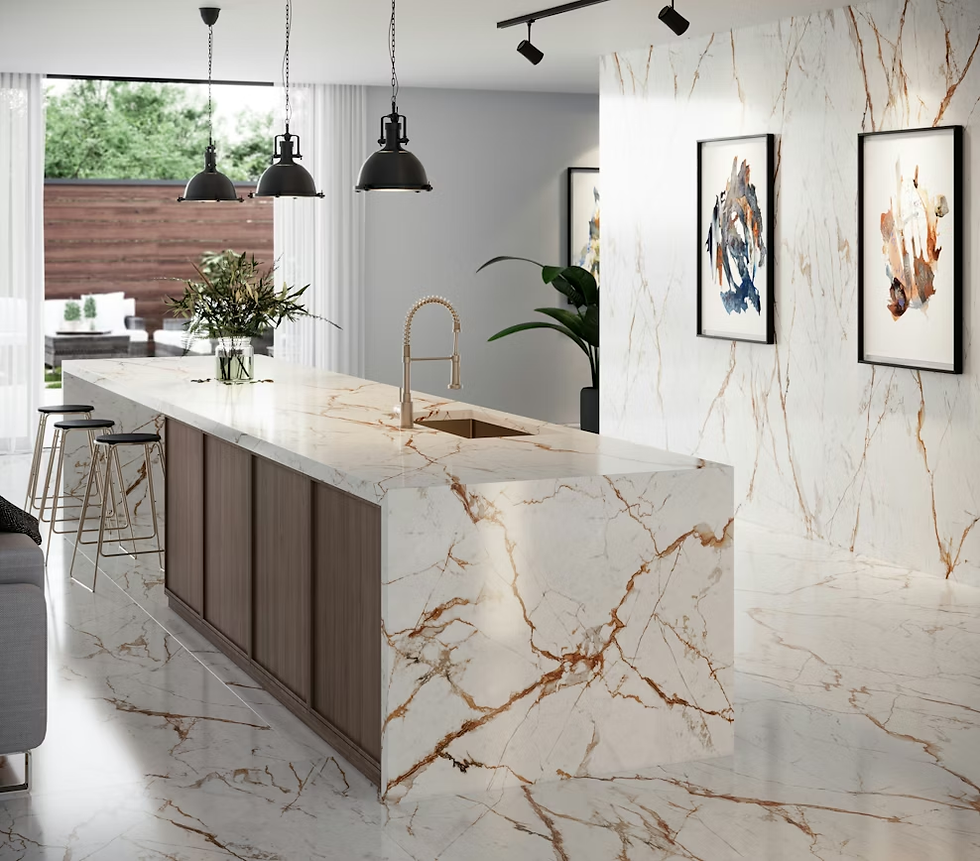
Porcelain slabs are relatively new to the residential countertop conversation but have earned their place quickly. Sintered at extremely high temperatures from natural clay, feldspar, and mineral oxides, porcelain is incredibly dense, non-porous, and requires no sealing whatsoever. It doesn't stain, it doesn't etch, and it handles heat better than almost anything else on this list — which makes it genuinely compelling for serious cooks.
What sets porcelain apart visually is the range of looks it can achieve. Large format slabs can convincingly replicate the appearance of marble, concrete, wood, and even metal — and because the pattern runs through the full thickness of the slab, chips and scratches are far less visible than on a surface where the design is essentially a printed layer. For homeowners who want the look of marble with none of its vulnerability, porcelain makes a strong case.
The practical considerations are worth understanding. Porcelain is extremely hard — it sits at 6 to 7 on the MOH scale — but that hardness also makes it more brittle than stone at the edges, which means fabrication requires a skilled hand and sharp edges need to be specified carefully. It's also thinner than most stone slabs, typically 6mm to 12mm, which affects how it reads visually and how it's installed. Pricing has come down as the category has matured, but a well-specified porcelain countertop from a reputable manufacturer still sits at the higher end of the market.
Where porcelain particularly excels is in outdoor kitchens. Unlike quartz, it's fully UV-stable, completely unfazed by temperature swings, and stands up to the elements without any special treatment. For a covered outdoor kitchen in an Atlanta summer, it's often the first material I reach for.
Beyond stone — wood and concrete
Wood brings warmth to a space that stone simply can't. What most people know as butcher block is actually an engineered wood product — strips of hardwood, typically maple, walnut, or oak, assembled and bonded together with the grain running in the same direction. That construction is what gives it the distinctive linear pattern and also what makes it remarkably stable as a work surface. End grain butcher block, where the strips are turned so the cut ends face up, is even more resilient and has a different, almost mosaic-like appearance that works beautifully in the right kitchen. It's the material that makes a kitchen feel lived in rather than designed, and in the right context that's exactly what a homeowner wants.
It does require maintenance: regular oiling to prevent drying and cracking, prompt attention to standing water, and an acceptance that it will develop a patina over time. For someone who loves the idea of a surface that tells the story of the kitchen, wood is a beautiful choice. From a pricing standpoint it's also one of the more accessible options — standard butcher block runs considerably less than most stone, while premium hardwoods like walnut close that gap somewhat but still offer strong value relative to high-end quartz or quartzite. Where it works particularly well is as a secondary surface — an island top paired with stone perimeter counters, or a dedicated prep area separate from the main cooking zone.
Concrete is the other material that deserves more consideration than it typically gets. A properly sealed, professionally poured concrete countertop is remarkably durable and offers something no other material can — it's completely custom. The color, the aggregate, the edge detail, the thickness, even embedded elements like drainboards or trivets — all of it can be designed from scratch. The weight is a practical consideration and the installation requires a skilled fabricator, but the result is a countertop that exists nowhere else. It also develops character over time in a way that feels intentional rather than like wear. For the right client and the right kitchen, it's one of the most interesting choices available.


The conversation that shapes everything
Before I pull a single sample from my library, I ask clients how they actually use their kitchen. Not how they intend to use it, not how they cook when they're trying — how they actually live in it. Do they cook every night or a few times a week? Do they have kids who treat the counter as a multi-purpose surface for everything from snacks to science projects? Do they entertain regularly, which means bottles and glasses sitting wet on the counter for hours?
Those answers determine the specification. The aesthetic is the second conversation.
I've sat with clients who were completely in love with a dramatic white quartzite — and it would have been genuinely beautiful in their kitchen. But they had three children under ten, they cooked every single day, and the idea of annual sealing and careful vigilance around citrus and wine wasn't realistic for their life. Specifying that stone would have meant setting them up for years of low-grade anxiety in their own home. That's not good design, regardless of how the sample looked under the showroom lights.
Where the specification meets the real world
Once the material is settled, there's a second layer of decisions that most homeowners don't anticipate until they're already in the middle of it: edge profile and slab thickness. A simple eased edge — slightly softened, clean, unpretentious — reads as modern and works in almost any kitchen. More elaborate profiles like ogee or dupont skew traditional. Neither is wrong, but they speak different design languages, and they need to agree with the cabinet style, the hardware, and the overall direction of the space.
Thickness is typically 2cm or 3cm for residential kitchens. The thicker option reads as more substantial, eliminates the need for a built-up edge treatment on islands, and tends to look more deliberate. These aren't finishing touches. They're part of the design, and when they're chosen without considering the whole picture, it shows.
Selecting the material is one thing. Making sure it's executed the way it was intended is something else, and that's where I stay involved long after the specification is written.
I'm at templating — the step where the fabricator comes in to measure before anything gets cut. It sounds procedural, but this is when the real decisions happen about where seams land and how the veining moves across the surface. On a stone with strong movement, a seam in the wrong place breaks the whole visual story of the slab. I'm in that room because my client usually isn't, and the fabricator's job is precision cutting, not design continuity.
At installation, I meet the crew. I want to see the slabs before they go in — checking for any damage from transport, making sure what showed up matches what was chosen, confirming everything is right before it's set and the decision becomes permanent. Fabricators and installers are skilled at what they do. But no one else in that room is accountable to my client the way I am.
A countertop is one of the most touched surfaces in a home. You see it first thing in the morning and last thing at night. It takes the weight of daily life in a way that most finishes never do. Getting the material right matters. Getting the execution right matters just as much. And that's a distinction worth understanding before the first sample ever hits your kitchen table.


Comments